
Roman graves seem to be a popular find lately in Israel:
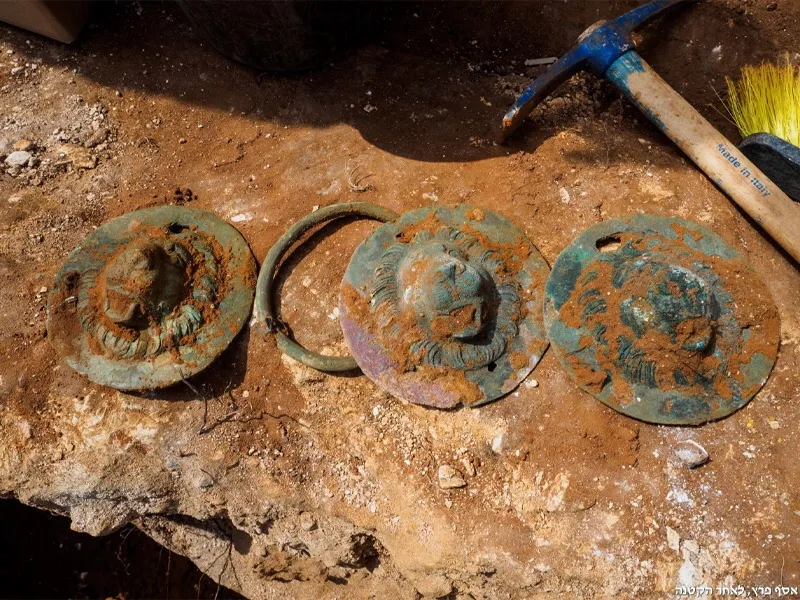
Archaeologists have discovered four bronze discs in a 1,900-year-old Roman grave in central Israel. The artifacts depict lions’ heads in high relief, each with slightly different facial features and manes.
The discovery was announced in a recent issue of ‘Atiqot, the journal of the Israel Antiquities Authority (IAA), though the discs were found in 2018 during a salvage excavation ahead of road construction.
The dig was conducted at an archaeological site known as Khirbat Ibreika near the city of Kfar Saba, located about ten miles northeast of Tel Aviv. According to the report, archaeologists unearthed eight Roman cist graves—burial chambers lined with stones—dating to the first or second centuries C.E.
In addition to the eight Roman-era graves, the 2018 excavations revealed traces of agricultural sites dating to the Byzantine period.
“The discs were found in one of the tombs,” co-author and excavation manager Elie Haddad, an archaeologist at the IAA, tells the Times of Israel’s Rossella Tercati. “The tomb was still sealed.”
In addition to the “unique, bronze lion-head discs and ring-handles,” the grave also contained human bones, glass vessels, wooden fragments and a nail, per the study. Researchers think the deceased was buried in a wooden coffin that has long since disintegrated.
Many mysteries surrounding the artifacts remain unsolved. No traces of Roman settlements have been discovered at the Khirbat Ibreika archaeological site, which was first excavated in 1995, as the researchers tell Haaretz’s Ruth Schuster. Additionally, the researchers aren’t sure about the newly discovered lions’ heads’ significance, though the animal “is known to symbolize strength, courage and nobility” in cultures around the world, they write in the report. Dozens of similar lion artifacts have been discovered in present-day Israel.
Wikipedia notes that Khirbat Iribbin also was called Khurbet Arubbin which translates as “the ruin of Arubbin.” Arub in Arabic means “Loves her husband”. It sounds like whatever the lions and the expensive burial were intended to convey, the message of a single burial implies most probably that the relationship status of the person was non-married. While the source article postulates the lions symbolized a Mithraic zodiac purpose as well as being coffin conveyances, it seems also that nobody cared enough to be buried near the person–or at least nothing survives if so within the reporting of the findings. The interesting point is that though the grave survives, the religious persuasion that led to this burial did not such that we do not entirely know whether these items signify a religious connection or a simple signal of status.