
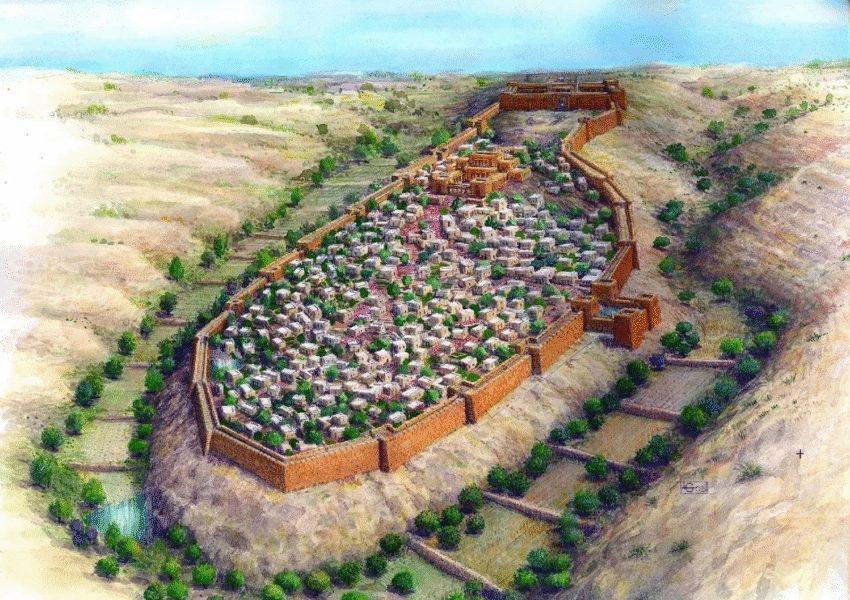
Jerusalem, it turns outs, was a major city during the time of David and Solomon:
One of the key revelations from the study is the discovery that Jerusalem was already a significant urban center during the time of Kings David and Solomon, contrary to previous skepticism suggesting otherwise. The research indicates widespread settlement and extensive construction activity during this period, challenging the notion that Jerusalem was merely an insignificant village. source: https://archaeologymag.com/2024/05/jerusalem-was-a-major-city-under-david-and-solomon/
An interesting additional finding concerned the eastern wall in the City of David:
Moreover, the study refutes previous assumptions about the construction of Jerusalem’s city walls. Contrary to popular belief, the wall in the eastern part of the City of David was not built by King Hezekiah, as previously thought, but rather by his great-grandfather, King Uzziah, following a major earthquake mentioned in the Book of Amos. source: ibid
Uzziah famously had trouble with power according to 2 Chronicles: 26:
11 Uzziah had a well-trained army, ready to go out by divisions according to their numbers as mustered by Jeiel the secretary and Maaseiah the officer under the direction of Hananiah, one of the royal officials. 12 The total number of family leaders over the fighting men was 2,600. 13 Under their command was an army of 307,500 men trained for war, a powerful force to support the king against his enemies. 14 Uzziah provided shields, spears, helmets, coats of armor, bows and slingstones for the entire army. 15 In Jerusalem he made devices invented for use on the towers and on the corner defenses so that soldiers could shoot arrows and hurl large stones from the walls. His fame spread far and wide, for he was greatly helped until he became powerful.
16 But after Uzziah became powerful, his pride led to his downfall. He was unfaithful to the Lord his God, and entered the temple of the Lord to burn incense on the altar of incense. 17 Azariah the priest with eighty other courageous priests of the Lord followed him in. 18 They confronted King Uzziah and said, “It is not right for you, Uzziah, to burn incense to the Lord. That is for the priests, the descendants of Aaron, who have been consecrated to burn incense. Leave the sanctuary, for you have been unfaithful; and you will not be honored by the Lord God.”
19 Uzziah, who had a censer in his hand ready to burn incense, became angry. While he was raging at the priests in their presence before the incense altar in the Lord’s temple, leprosy[c] broke out on his forehead. 20 When Azariah the chief priest and all the other priests looked at him, they saw that he had leprosy on his forehead, so they hurried him out. Indeed, he himself was eager to leave, because the Lord had afflicted him.
21 King Uzziah had leprosy until the day he died. He lived in a separate house[d]—leprous, and banned from the temple of the Lord. Jotham his son had charge of the palace and governed the people of the land.
The finding is a reminder no matter how powerful or large you or your kingdom might become, it is unwise to transgress the order YHVH has established.